20101028

The installation.


Please go under the strings and stand between strings.
There is a tiny space like a corridor.
Close your eyes and take a deep breath.

When you open your eyes,
you may regard only tree and strings.
If the sunlight is a strong, you might be able to see the white strings clearly.

Then, please walk from towards one of the trees.
Your body may feel the strings touching you.
You may notice the dynamics of the space.
It is changing its shapes all the time, by wind and body.

You might invite your friend inside.
The tiny corridor space may be able to become a tiny room.
What you need is only push the strings a little with your body to make the space wider.
When your friend pushes the strings, your body may feel the push, because your body is touching the strings.

If you hold some of the strings above your head and pull it,
you may see the twigs are bowed.
Also when the twigs are bowed, you may feel the movement of strings and changing the space.
There is a correlation between tree and you through the strings.

This space is variable and dynamic.
Its perspective is changing all the time by your body movement, your friend’s action, or a spring breeze.

Please try.


I now have a few questions for you.
Could you tell me what you find?


http://www.facebook.com/album.php?aid=30393&id=150972124948218&saved

20101023

Environmental ethics in the field of the architecture/建築分野における環境倫理学

Environmental ethics in the field of the architecture
I would like to challenge and critic to “green architecture” as a latest fashions of architecture. In my opinion, current green architecture might be blind to environmental ethics. Although the studies or testing of new technologies to saving energy use or material use have been developed, there are lack of ethical studies. As the research methods may have significant effect on the research (Linda Groat and David Wang 2002) research of green architecture need to consider methodology too. Architectural research of environmental problems may needs ethical point of view as well as scientific one.
Environmental ethics are also blind of city or people’s living environment and this is a crucial mistakes for ecological reasons (Andrew Light 2001). I think that ignoring urban environmental issues in the field of environmental ethics and ignoring ethical issues in the field of architecture indicative environmental ethics of green architecture is totally emptiness.


   Andrew asks us that whether living lightly on the earth means really environmental responsibility. If so encouraging urban dwelling does more good for the environment, when we based on the one of the scientific research data explain that more urbanaised cities tend to use less energy than country side (Andrew 2001). However, Rolston criticized big-city life which is foreign to our native, earth element (1998). The deep ecology of Arne Naess discuses the importance of experiencing wildness as the sores is human attitude change (Andrew 2001).
I now want to go back to the topic of the green architecture. Saving energy use is concerned as a one of the goals of green architecture and is contained in environmental rating systems. I think the field of architecture need to exam whether saving energy use means really environmental responsible architecture. I asked to myself and answer is... may be yes, but not enough.

Is Nature “other ” of architecture?
In my opinion, green architecture may need to be not as a others of nature. The reason is that nature may have been treated as others by architecture and this could be problematic.
According to Igarashi, architecture’s primal vision is of conquering nature and architecture haven’t get out of this primary vision (2008). He says gardens are also artificial nature contoroled by people (2008). “Le Corbusier’s Ville radieuse and New York Central park are both natute abduced into the ueban core, even tree houses merges nature. (Igarashi 2008)

    From the environmental ethics point of view, the environmental problems are often argued as a conflict between people and nature or diveloping and protecting (Kitoh 2010). Kitoh points out that the main environmental discussion in 19th century is conservation, in other words, protecting nature for people’s profit (2010). On the other hand, 20th century’s mainstreams is environmentalism which against the concept of human centric (Kitouh 2010). In my opinion, although the ideas are different, both of them seems based on dualism; people and nature, self and otherness. From the reading of “the sex of the architecture(1996)” I learned that diversity of groups has risks to create problems like unfairness, especially the categorizing into two groups; self and other. Therefore, I would like explore the way to produce architecture not as other of Nature. 


昨今の最新の建築ブームとも言える「グリーンアーキテクチャー」について考えてみたい。グリーンアーキテクチャー(環境にやさしい建築)には環境倫理学という視点がかけているように思う。エネルギー使用を押さえるためのテクノロジーや、新素材が研究され、テストされてきている一方で、倫理面からの研究は進んでいない。研究方法は結果に大きな影響を与えるものである(リンダ・グロート、ディビッド・ワン 2002)から、グリーンアーキテクチャーの研究・開発においても方法論を熟慮する必要があるのではないか。環境問題に対する建築的な研究は、科学的な視点と同時に倫理的な視点も必要であると思う。
環境倫理学の分野でも、都市、あるいは人間の住環境についての視点が欠けており、これはエコロジカルな面で非常に重大な失敗である、とアンドリューは指摘している(2001)。都市環境問題について、環境倫理学の分野の取り組みが遅れており、同時に建築分野での環境倫理への考慮もなされていないとしたら、「建築分野における環境倫理学」は今、まったくのブラインドスポットといえるかもしれない。

アンドリューはわたしたちにこう問いかける。地球に負担をかけずぎすライトに暮らすことが本当に環境に対して責任をとっているということになるのか?もしそうなら、人々に大都会に住むよう進めることが環境に良い、ということになる。都市生活の方が郊外の田舎暮らしよりエネルギー使用量が少ないという科学的なリサーチデータが発表されている(2001)。しかし、ロールストンは巨大な都市での生活は、私たちの本性、地球的な要素とはかけはなれていると批判する(1998)。ネスのディープエコロジーは人間の行動を見直し変えるきっかけ作りとして、原生自然との経験の重要性を訴えている (アンドリュー 2001)。
グリーンアーキテクチャーに話しをもどそう。エネルギー消費量を抑えることは、グリーンアーキテクチャーのひとつのゴールとして位置づけられている。建築がグリーンかどうかを数字で表す評価システムの項目に含まれている。果たして、エネルギーの消費を抑えることが本当に環境に対しての責任をうけおっていることになるのか、建築のフィールドはきちんと吟味しなくてはいけない。私は自分自身に問いかけてみる。答えは、たぶんイエスだ、でもそれだけでは十分じゃない。


自然は建築の他者なのだろうか?
グリーンアーキテクチャーを自然に敵対する他者として考えるのをやめてみたらどうか。建築は自然を他者として扱いつづけてきたが、それが昨今の問題につながっているように思われるからだ。
五十嵐によれば、建築の原始的な目的は自然を制圧、支配することであり、建築はいまだこの原始の視点から脱しきれていないという(2008)。彼によれば、庭ですら人間にコントロールされた人工の自然であり、ル・コルヴィジュエのVille radieuseもNew York Central parkも都心に拉致された自然であり、ツリーハウスでさえ自然を制圧するものだという(2008)。


環境倫理学の視点からみると、環境問題というのはよく、人間と自然、開発と保護の二項対立として議論されつづけている(鬼頭 2002)。19世紀における議論の主流は保全、つまり人間に有益であるよう自然を守るというものであった(鬼頭 2002)。一方で20世紀では人間中心主義に反対しての環境中心主義、保存という考え方だ(鬼頭 2002)。意見は違っているとはいえ、どちらも人間対自然、自己と他者という、二元論に基づいているようだ。ところで、1996年に出版されたセックスアンドアーキテクチャーを読後、私が強く感じたことは、ものごとをグループわけするときには、そこに不公平や不平等が生まれる危険性がある、ということだ。自己と他者の二つのグループにわけられるときはとくに。だから私は、自然の他者ではない建築をうみだす方法を模索したいと思う。

20101020

Link together. Living together./ Kampung improvement and development, Yogyakarta, Indonesia.

Kampung (urban poor) improvement and development.
Design proposal from urban planning to renovation of mental hospital.

This design encourages living together.
Living with water
Living with green
Living with "other" people
Living with community
Living with neighbors
Living with family


The architecture that I propose is a part of the project, but not sculpture.
The project that I suggest could be a pert of people's life.
The design is based on the idea that everything is a part of something.

Development and Environmental protection
Tradition and New Technology
Respect local custom and show other sense of value
Bottom up strategy and Top down strategy
Communism and Capitalism

Do we have to choose one from two? Why?
Do you think one is more excellent than others?
Are that two really opposition?
Are you sure?

This proposal would improve both of public hygiene and quality of river water.
This building respects the local people's traditional life style ; living with community.
This building also privide the private spaces have different characteristics.

Respect each other.

Link together.

Living together.


http://www.facebook.com/album.php?aid=30390&id=150972124948218

20100902

Otherness / Possible application into architecture.

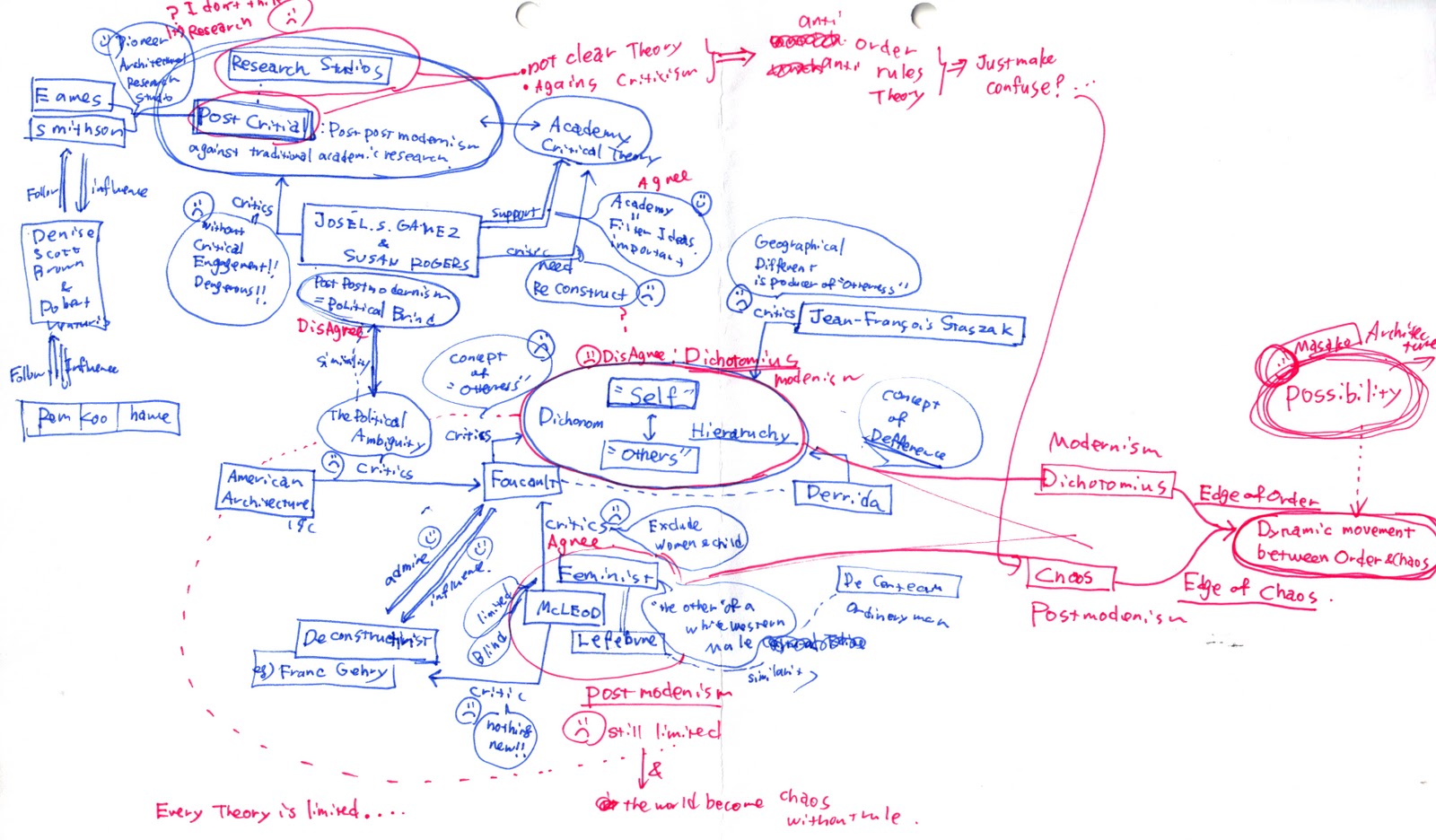
First of all, I believe that design has ability both of to improve quality of life and to give negative effect. Therefore, I strongly think that designer should carefully examine their ideas. Gamez and Roges’s say that academy’s role is filtering ideas by theories that are tool for testing. I support their opinion that the field of architecture needs new academic theories that engaged with current society. Varnelis explains that recent projective architects’ post-critical thought has attack critically and theory. I am worry about this situation.


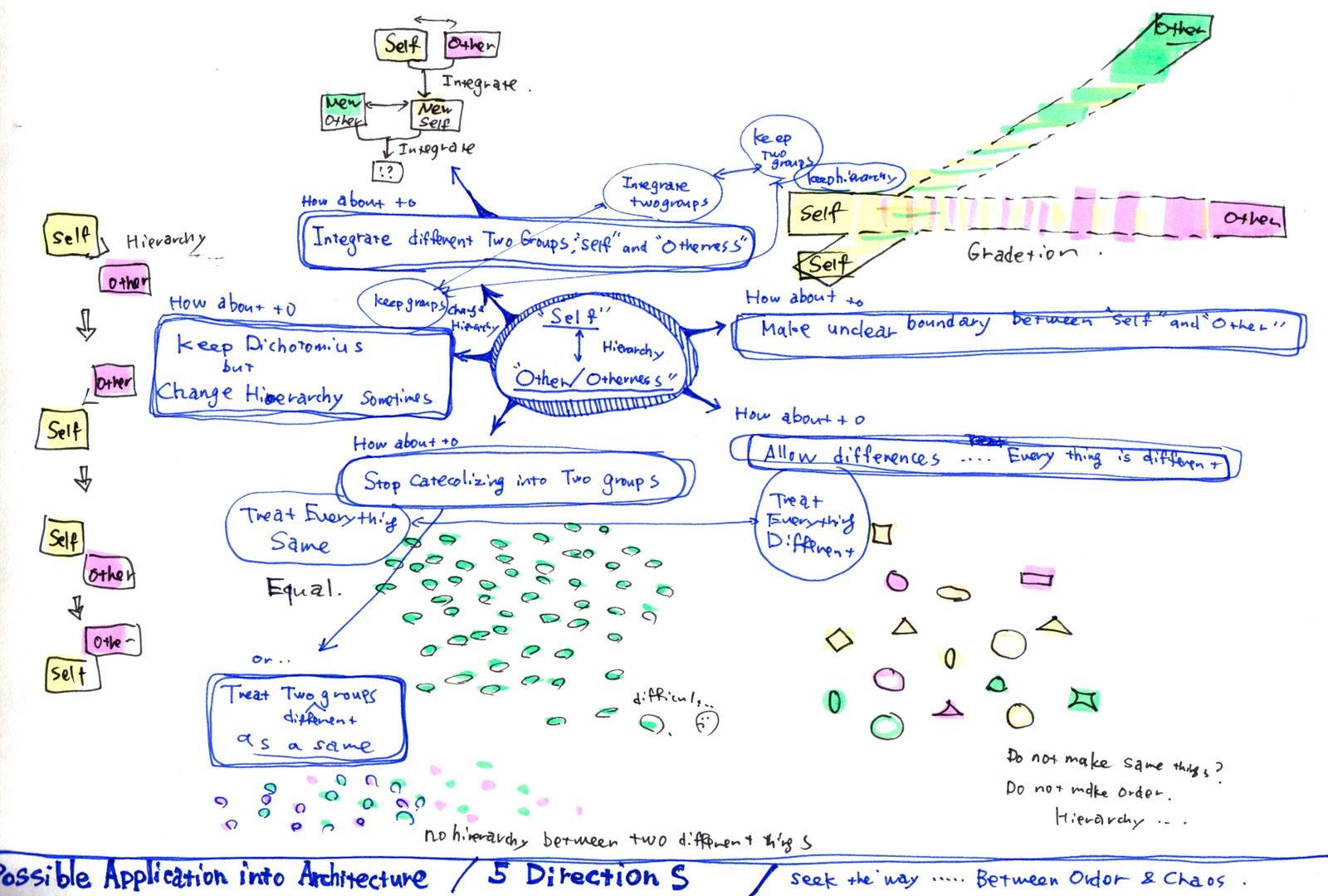
It is the main idea discussed in the sex of the architecture and key concept of feminism. I would like to try to propose some architectural suggestion for the concept of the “others”. I think that the issue is unfairness social systems with hierarchy that is produced by the concept of other. Diversity of groups especially the categorizing into two groups; “Us / Self” and “Them / Others”, has risks to create unfairness. How can design contribute to solve this problem? I have 5 different suggestions.


Change space hierarchy sometimes by space design.
On the supposition that people want to have a concept of “Self and Others” and want to feel superiority, my suggestion is keeping structure of hierarchy but change the order of power frequency. I believe space design has ability to change people or object’s value.

Make everything different.
Make every single object have different form and different size.   I think when everything is different, then we can not cartelizing spaces into dichotomies groups. We can just only align every single element equally. The hierarchy might disappear. 

Make Ambiguous boundary by gradation.
How about to make unclear boundary between each two factors? If I list up “Self/other“ as much as possible and remove every clear boundary, Can I create spaces without any hierarchy?

Tread two different things equal.
For example, old existing buildings and new buildings, artificial elements and natural elements.

Integrate two different groups


20100830

“An Architecture of change”

Review of “An Architecture of change”

Gamez and Rogerd state that we are now in the post critical and post political age, the new age after postmodernism. The authors warn of this current situation where current architects tend to be politically blind. I agree that the field of architecture tends to separate from the field of politics. However, I guess it is not because architects have become politically blind but architects intend to make architecture free from power. I think this attitude is a critic against modernism which have strong connection with politics. For example, the public housing projects and urban planning in modernism had strong connections with political aim and it has failed. 

Gamez and Rogerd’s points out that current architecture does not contribute in real issues except for a few rich people who are only 2% of the population. For the improvement of this situation, the authors think that the field of architecture needs new theories that can transform architectural practice into the societal and political fields. I think it is necessary to engage with societal field but not sure with politics. The political project in architecture has already disappeared from main stream architecture. Why we now need to engage with politics?

I agree with the authors’ opinion that academia has important roles in filtering the idea or movement. So I think it is very variable to seek the ways in which architectural academy may engage with existing world issues. I believe that the field of architecture has possibility to contribute in solving or reducing issues but have not work well yet.


Gamez, Josel, S. and Rogers, Susan. “An Architecture of Change”.  Expanding Architecture: Design as activism. ed. Bell, Bryan and Wakeford, Katie. New York: Metropolis books, 2008: PP18-24.

20100827

“Is There Research in the Studio?”

Review of “Is There Research in the Studio?”

In my opinion, research should examine the fact, give us new finding, explain it clearly and logically, and expand our knowledge. I think the research studios help us to understanding the city or architectural thought but didn’t produce new knowledge. In my opinion, these research studios are like communication tool rather than research.

Same as the Eames’ film. I do not agree the film is research. I have watched Eames’ film ‘Power of Ten’ that Varnelis states as the best analogy for research studio. I felt the film shows the new images of the world which I do not imagine in ordinary life. The film gives us new awareness but does not have new findings. It is a specious idea that the film is research simply because it helps us to re-imagine the world. I do not think the film expands our knowledge even though I think the film could be architectural but not research.

According to Varnelis, new “projective architecture” against criticality and theories over last decade. Therefore, the research studios have become common. I think if the project doesn’t engaged with theory or criticality, it may no be called as research. In conclude, “research studio” could be new way of architectural communication but not research.


Varnelis, Kazys. “Is There Research in the Studio? ”.  Journal of Architectural Education. (2007): PP11-14.

20100824

"Other / Otherness"

Review of "Other / Otherness"

Stazak argued that otherness is produced by geographical differences such as physical anthropology and history. Differences in biological sex, religion, language, political structure, and skin color are also contributed to construct otherness. Does difference create others? If so, is difference problem?
I disagree Stazak’s that difference has been produced the other and otherness. I believe that what creates the others is people’s desire to identify themselves. When people use difference to create other for the purpose of domination, the issue of unfairness could happen. I believe that the issue is not difference but hierarchy which is produced by the concept of otherness.

According to Stazak, “Biological sex is difference, whether gender is otherness” I can accept the idea that my body is female which is different from male in terms of biology, because it would be in the realm of fact. On the other hand, it is not convincing that female hard to be architect in Japan. It is gender that belongs to the term of discourse. It is qualitative judgment that males can work as architect better than female. It has not quantified or proved. Gender issue is that people who are not male; who are excluded from “self”. I believe that difference is not the problem but some people’s desire of supremacy creates others from differences. 

My question is whether “other / otherness” is issue. According to Jean-Francois Stazak, otherness has been used as explanation of the morally rightness of domination by dominant group which was defined as “Us / Self”. The concept of otherness would be considered as a excuse of unfairness, injustice and inequality between “self” and “other”, for instance, Male/Female, Believers/ Non believers, white/ colors and so on. When I stand by his idea and then judged otherness from moral point of view, the concept of otherness seems like contributing many issues existing the world. However, I should remind that this is value judgment but not fact.

I think I need to consider what modernism and postmodernism have tried to do. Modernism believe universalism could be best solution of unfairness because unbalance society systems are created by difference.  However, it failed. Some people couldn’t stand to lose their identity. From this history, I think it is nearly impossible to not have concept of others.

In conclusion, concept of “other / otherness” is not be able to disappear as long as people want identify themselves. In my opinion, we should remind that diversity of groups has risks to create unfairness. Especially the categorizing into two groups; “Us / Self” and “Them / Others”. Essential problems are unfairness and unbalance but not difference, not the concept of others. 


「他者」という概念は、自然人類学的あるいは歴史的な地理上の「違い」によって生みだされるとスタザックは言う。生物的な性の違い、宗教、言語、政治構造、そして皮膚色の違いなどもそうだ。「違い」が「他者」という概念をほんとうにうみだしているのだろうか? そうだとすれば、「違う」ということは問題なのだろうか?


私は「違い」が「他者」や「他者性」をうみだしつづけてきた、とは思わない。人間の自分自身のアイデンティティを確立したいという希求が他者という概念をうみだしたのだろう。人間が「違い」を、「他者を支配する」という目的のために使いはじめたときに、不公平という問題がおこりえる。私は「違い」が問題だとはおもわない。しかし「他者」という概念によってうみだされたヒエラルキー、階層構造は問題視すべきだと思う。


スタザックによれば『生物学的な性は「違い」であるがジェンダーは「他者性」である』という。なるほど確かに、わたしは私の身体が生物学的に男性とは違う女性であるということを受け入れることができる。なぜならそれは、事実という分野に属するからだ。一方で、日本では女性が建築家になることが難しい、ということにはなっとくがいかない。これは、論説の分野に属するジェンダーの問題であり、事実の分野にぞくする生物学的違いとは一線を画する。男性の方が女性よりも建築家としてよく働ける、というのはクオリティ的なジャッジメントである。ジェンダーの問題というのは、男性ではない人々、つまり「自己」「私たち」というグループから除外された人々への不公平という問題である。問題とすべきは「違い」ではなく「違い」を理由に優越感をもちたいという一部の、あるいは大部分の人間の欲求である、と思う。


では、「他者」という概念は問題なのだろうか。スタザックによれば、「他者」という概念は、「わたしたち」が「他者」を支配するときの理由、モラルのうえでの正当性として使われて来た。「他者性」とはつまり、「わたしたち」と「他者」の間にうまれる不公平、不平等に対する言い訳としてつかわれてきた、と言えるだろう。「自己、私たち」と「他者」、たとえば、男性と女性、信者とそうでない人、白人と有色人種など。スタザックの意見を前提に「他者」という概念をみてみると、「他者」という概念は、世界中のたくさんの社会問題に寄与して来た、問題の原因そのものであるかのように思える。


さて、私は、モダニズムと、その後のポストモダニズムが何をしようとしたのかを、ここで一度考えてみる必要があると思う。モダニズムは、不均衡な社会システムは違いによってもたらされいえいるので、ユニバーサリズム(普遍主義)が不公平の最も良い解決策であるかもしれないという信念に基づくものだったといえる。 しかしながら、それは失敗したように思う。 何人かの人々は、自分のアイデンティティを失いみんなと同じになることが耐えられなかった。 この歴史からは、私は、他者という概念をなくすというのは不可能ではないかと思う。


結論として、人々が自分自身がなにものであるかを知りたい、確立したいという人々の欲求がある限り、「他者/他者性」の概念が消えさることはないだろう。しかし、私たちは、違うグループにグループわけすることで、不公平をうみだすかもしれないというリスクがあることを忘れてはいけない。「わたしたち」と「かれら」つまり、自己と他者の二つにグループ分けするときは特に。本質的な問題は、違いでも他者という概念でもなく、不公平と不均衡にあるのではないだろうか。


Staszak,Jean-Francois. “Other/otherness”.  International Encyclopedia of Human Geography. (2008).