Showing posts with label 英語. Show all posts

20120708

slow and gradually change....


I’m so sleepy. I feel like having a lazy evening. My heart is not strong enough to keep myself working hard. I always start doing what I want to do. I tend to run away from things I feel are boring, even though I knew that boring things are important. Learning grammar, using a dictionary, practice of pronunciation, and being careful in my use of English, are important in terms of improving my English, yet my lazy heart often says ‘hey let’s take a break!’  If I didn’t live with Mr.Spinks, my strict English tutor, I would not be writing this composition today.  

On the other hand, I have drawn and painted sceneries, read a newspaper, magazine, and ‘the Great Gatsby’ today, without anyone supervising me. The reason is simple; These are fun, so I like to do them. I read a newspaper and magazine at a café without any pressure. It has become my daily habit. If it is sketches, it is more than a daily habit. I’m addicted to drawing things in my sketchbook. I do feel anxiety when I go out without my sketchbook. I don’t need anyone to tell me to do it, I simply do it. I believe that if I keep working on my sketch journals it might be able to bring me my dream life style, but more than anything, I love to do it.

However, I noticed that my daily habit above was starting to be under pressure. I knew it all began from pushing myself harder. For example, I am just recently feeling comfortable to read more than ten pages per day of an English novel. I read ‘Across the river and into the trees’ before ‘The Great Gatsby’, and it took a long time to read it. I often ran away from Hemingway’s novel written in English and jumped into novels and essays written in Japanese during the last few months. Mr. Spinks asked me ‘have you read Hemingway today?’ almost every day, and my answer was often ‘not yet.’ 

3 years ago, it seemed impossible to enjoy reading newspapers or magazines for me. I often gave up reading before I finished one article, because it was too difficult and too long for me. My former English teacher recommended that I read a newspaper every day.

Drawing and painting were also not my daily habit either. I remember I forced myself to do one sketch every week. It was difficult to follow my rule to achieve goal because sketching was lots of work for me as a lazy person. It was also 3 years ago when I started my life overseas in Tasmania. I carried my sketchbook only on weekends and I sometimes came back home without filling any pages of the sketchbook. 3years- actually 3 and a half years- practice has definitely improved my skills. It was a slow and gradually change, but things have definitely improved. I know it, but I also know what a lazy person I am. I hope I will keep working on my English.


20120405

Our house got new friend, lovely little one!

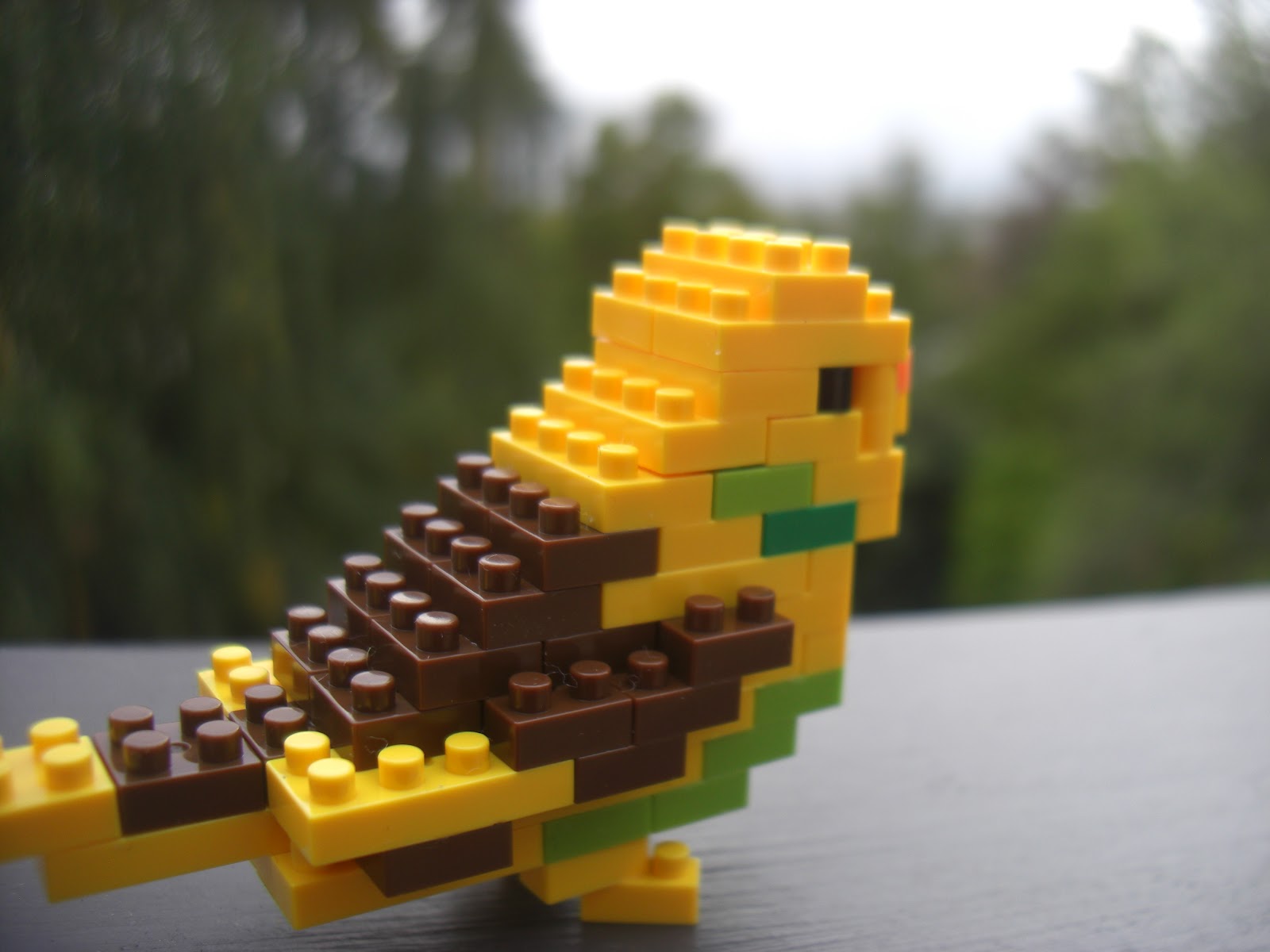
Our house got new friend. Look at this lovely little yellow one!


I made budgerigar by nanoblock that my sister brought from Japan.
Isn't she so pretty? I decided to call this baby bird 'little princess'.
She has just been born today. 
Every world around her was fresh, new and interesting. 
Flapping and flying in our house. 
"Where are you baby?"


There she is!
She is in our sharing book shelf in library.


"What did you find my little princess?"
She is on the book "Speak, memory" written by Nobokov.
 "Would you like to read this book?"


Chapter one
"The cradle rocks above an abyss, and common sense tells us that 
our existence is but a brief crack of light between two eternities of darkness."


"Hey hey, you don't need to run away from me. I understand your feeling, little princess. 
Nobokov's writing is little bit too difficult to enjoy, isn't it?
I also tried to read this book but I stopped to read it on P14.
My house mate who love Nobokov so much had  recommended me to read it for learning beautiful English, 
but I couldn't continue reading at the moment.
Too much difficult new words in one sentence.
He does love Nobokov so much."
I tried to talk to the yellow baby girl, but she seems not interested to listen. 


Our terrace attached to library has fascinating view.
We can look down city between trees, and mountain lays down far away.


"Would you like to fly around our garden?
If it is too scary for you, I would like to take you to down stairs and show our garden.
It's ok. No worry."


Good girl.
I would like to introduce little princess to George who is sitting on a blanco. 


I have been friend with him science March in 2009 .
3 years has already passed. Time fly.
George is Tasmanian wombat.
He was born in Tasmania, grown up in Tasmania 
and has never been out side of Tasmania.
He is innocent and honest good boy, so we can be friend 3 years.


Little princess seems so happy all the time.
Hopping from leaf to flower, flower to leaf.


"smell yummy!!"


Oops! Careful!
Don't fell off.
I'm making vegetable soup, but
I don't want to see chicken soup on dinner table tonight!


20110430

The dance of flame.


The hot days of summer has already passed in Tasmania.
The air is growing colder and leaves are turning into autumn.
I'm sitting near fireplace, warming my toes and fingers, and listening the chatty snappy fire.
During I was drawing couple of sketches,  the tall young guy walked out from bar counter and  added wood to the fire.
The fascinating dance of flame and the smell of bonfire, adding to my excitement.

Since I came down to Hobart on Sunday, I have been in peaceful quiet world.
I didn't bring my laptop and didn't touch any computers in this short easter trip.
No internet,  no facebook, no blog, no usetream, no news.
I guess it contribute to settle down my emotion.
Before this easter holiday, I had been busy on net surfing to search information about post disaster situation in Japan, especially nuclear power plant.
Japanese government, politicians, scientists, mass media, individual blogs, and friends have been uploading  news and I wanted to catch up.
I sometimes feel sad and depressed, sometimes got angry  and I was often disappointed.
It is not clear what information is truth.
I am wondering what should I do and where should we heading to.
There have been huge storm in my brain and heart from 11th March.
Because of this no internet trip, I now notice I was busy to searching information on the Internet.
I just bring my sketch book and one book; blossoms and shadow written by Lian Hearn.
I also notice that I didn't read much books these one month.


Walking in the autumn Hobart city with my sketch book and mapping the type of green -this is a part of my research- in the morning.
Cooking simple vege-soup pasta for my lunch at the kitchen at the backpacker.
Reading the book in the evening.
Watching  the dance of flame with a glass of beautiful scarlet colour drink -which the guy serviced to me, so I don't know the name.
Drawing whenever I want to do.

Traveling by my self is not so bad.


26th April 2011

20110401

Japanese night / Fundraising

Time
01 April · 16:00 - 20:30

Location
Uni bar, UTAS, Launceston, Tasmania

Created by:

More info
Do you like SUSHI?
You will find yummy 'Teriyaki Chicken Sushi' &
'Vegetarian Sushi' at Friday night!
All of sushi are hand made with love :)


Are you interested in Japanese culture?
Why not join fun Japanese night?
Japanese traditional music & pop music are waiting you♪
Have you ever made ORIGAMI craft?
Let's make beautiful paper crafts together!
Do you know how to spell your name in Japanese?
We will help you to write/draw calligraphy style your Japanese name.
The Japanese style paintings will be there as a post cards.


All of profits will be send to earthquake victims in Japan:)


We will up load more information soon :)


Any question?
Please write down on this wall or contact with
Masako Matsumoto / Masako Morita

20110314

What can I do?

What can I do?
Think. Think quickly. as quick as possible.
Think about people in Japan.
How are they feeling now?
What do they need?
I can not feel exactly same as people in Japan,
but
Imagine.

It's just so painful to sit in front of computer and just watching news.
Talking with someone I like and the one living in Tohoku area.
If I was beside her, I could hug her. but I'm now far from Japan.
I can not call all of the friends, because I know that everyone now try to save power in Japan.
I don't want to let friends' phone waste ther power.
I'm in Tasmania, so I can not give her big hug. What can I do?
If I was very rich, I could send a lot of money. but I'm not rich.
The money I get from my casual work is just enough to support my living cost.
well.... I might be able to donate a little.
When I get tips from the customer at restaurant, I will use the tips for donation.
Does it help?
I might be able to set donation box at the restaurant or/and uni.
Yes, it's not impossible.
What else?
What else I can do?
Think about it.
I have a assignment which due is just 3days later, so I don't have time.
Am I sure? Why I don't have time? I may be able to make time.

Face the situation Mako!
Japan and my friends and my situation.
I'm in Tasmania, far from Japan,
but I believe there are something I can do.
I'm student, don't have money but have assignment.
However, there must be something I can do.

Think a lot!
Think quickly!
Think .
and
Do it!

20101103

GREEN ARCHITECTURE? / The installation as a research in architectural design.


Theoretical framework
The aim of the design is to urge users to perceive dynamic relations in the world. 
    This is based on the concept of nature as a continuance of people, not as an opposition. There is a close correlation between ourselves and the world inclusive of nature. Ourselves and nature can not be divorced from each other.
These ideas that thinks about nature in the world of relationship is expected to advance the improvement of environmental problems in the field of environmental ethics (Kitoh 2010). Morikawa also discussed the importance of understanding nature as a continuance of people (2010). However, environmental ethics are blind to the city or of people’s living environment and this is a crucial mistake for ecological reasons (Andrew Light 2001). In the investigation of the interconnection of meanings in life-world, philosophers, humanists, and social scientists tend to forget that the problems of body and spaces are related to these considerations (Yuasa 1987). Therefore, I think it is meaningful to translate the idea of world in the field of environmental ethics into the architecture. I believe it would help architecture to contribute to the improvement of environmental problems. 
    To materialize the dynamic relation of the world, I would like to assimilate Japanese classic theories into the installation. The reason is that Kitoh’s idea and Japanese classical theories may have similarity. In the design process, I explored the essential ideas lay down in Japanese classical philosophy generated by Dogen, Yuasa’s body-mind theory, Japanese classical architecture and garden to engage with environmental issues existing the world. 
    The installation is designed as a research in architectural design that engages with environmental problems (that would be my future project). It is an experiment in the possibility of architecture, whether architecture can inspire users to consider environmental problems.  
The goal of exploring the material and structure of installation is perception that everything has dynamic correlation with each other; Nature and people, self and other.


The process and relation to theory
Original plan of the installation is the space filled by strings curtain(fig.1). The space is expected to change its shape by wind and body movement. People in the installation may feel the dynamic space through the strings touching their body. MDF board would be structure that support strings. 


   Firstly I choose the site carefully because the connection of outside world is highly important in this installation. I chose the site where direct sunlight and blowing wind can be obtained. The installation is located in front of architecture building, next to the castle (other students’ work). This is because to make contrast between static space of the buildings and dynamic space of installation (fig.2). I chose the tree standing against the background of the text “ARCHITECTURE + DESIGN” (fig3). It suggest the installation is for architecture + design. After the experiment in the installation, some of the user may find the text behind tree and may compare the dynamic space of installation and the buildings. These idea is based on “Shakkei” one of Japanese garden’s technique.Japanese gardens are not complete in themselves. They tell us that all of the mountains, sky, and the universe as a whole are an extension of a garden (Kuma, 2010). The essential idea of Japanese garden is similar to Dogen’s philosophy. Dogen’s understanding of the world is an extension of ourselves (Yorizumi 2005).


Second stage is placing MDF board under the tree. As wind is too strong to keep MDF board parallel with ground, MDF is fixed on branches (fig.4). Thirdly, the end of strings is fixed on MDF board. The strings do not work as intended in my aims. The wind move strings too much, therefore people cannot feel our body moving the strings. People may not be able to perceive strings movement caused by both of wind and body. Moreover, many strings became one bunch, looking like a thick rope (fig5). This original plan appears to have failed.


   After a failure of first plan, the material is reconsidered. Translucent paper is tested instead of strings because it might be heavier than strings, but does not work too (fig.6). Wind move the paper too much for people to be able to feel the movement by their body. 


  Because of second failure, the 
structure may need to be reconsidered. When the other end of paper is fixed, it could save too much movement from the wind (fig.7). When the direction is changed from vertical to horizontal, the material could move softer, enough to create interaction between body and materials (fig 8). Changing direction to horizontal may have significant effect on looks. However, the form is not so important but to create interaction between body and materials is more important for my installation, based of the core theory. In the ‘Rediscovery of Japanese beauty’ written by Taut, he says that European architects remain in a world of forms, on the other hand Japanese architects have lived in a world of relationships. (Kuma, 2010)


Furthermore, material is also reconsidered. The strings may suit because it stronger than paper. There are many different types of strings at shops, for example plastic strings and cotton strings (fig.9). I chose cotton strings as it feels as if it is something comfortable to the body because I want people to enjoy their perception through their body long enough to notice the theory behind the installation. The physical sense of moving awakens the mind to shift in mental attitude (Kuma 2010). In the active status of body-mind identity, the ambiguous dichotomy of the body disappears (Zeami 1363-1443). If the installation works well, people may not feel body and mind are separated. If the space works successfully, people feel self and others are connecting. 


The cotton strings and horizontal direction works better than any other test before, so I decide to use it. The strings are coiled between two trees (fig.10). Then the density of the strings is increased. I used 2 and half ball of the strings. 1 ball is approximately 530m, therefore, total length of strings is around 1800m. The strings are placed from the top of the trees to nearly ground. To enter the space, people need to bend their body, bow their head and lift some strings up. “The gentle motions of inclining the head or blushing aside the cloth is surprisingly amplified and makes us aware that we are passing into a space of a different quality (Kuma, 2010).”  

The next stage is inviting people 
and seeing their reaction (fig.12)
This artifact is not complete in itself. This installation works when people are inside to have interaction.


   Caption next to the installation may need to avoid explaining the concept too much. The reason being that the aim of the installation is to perceive through the body without prior knowing from story telling. The perception through body is highly important in Dogen’s theory (Yuasa). I would like to let people feel something free. In the tea-room it is left for each guests’ imagination to complete the total effect in relation to themselves (Okakura, 1906). To make this design outcome as a research, I want to know what people feel without knowing it as a research project. Therefore, I put the installation but not explanation of the installation (fig.13).


   To collect feedbacks, I prepared question and answer sheets. However, I could not get answer sheets as same number as people who tried the installation. Some people said to me the question is too difficult to answer. This question sheet may need to be improved. Finally I decide to be near the installation and talk with people to get feedback.

During the open day of the installation, I remove unnecessary structure, MDF board (fig.15). The reason is that the boards are not necessary to support the structure of installation, but might disturb people’s attention and their body. Around 8 people asked me about the MDF board on the branches. My final outcome ended up with using only strings (fig.16). 


Accident happens. On thursday morning, I found that some of the strings are cut and some of strings have lost their tension. As a result, there is a less interaction between body and strings. On the other hand the movement of strings became dynamic and complicated. It may work differently compared to the day before. One more ball of strings (530m) is added. The density of strings become higher and the movement of strings become complex. I invited people again and looked carefully at the difference. This time, it looks like it gave people more surprise and is more entertaining.


Response to artifact / self reflection
From the question sheets and some interviews, most people have a strong impression of the strings. Some of the people mentioned wind and other people’s movement. However, nobody talk about the connection with the outside world. The installation may fail to evoke the infinite dynamic relations of the world outside. This installation does not work as an architecture engaged with environmental problems. However, based on these findings, it would allow me to explore other ways in the future.
   People’s strong impression of the direct interaction between body and strings is more than I had expected. On the other hand, wind, other people or outside world did not give a strong impression, it may be because these elements do not touch the body directly. Perception through body might really be stronger than I expected, and perhaps this is something that I can use to explore to make a more material connection to outside world.
   As a research, my project may need improvements to collect more feedbacks from various people. This will provide for more valuable data. Most of the guests are architecture students. One of the reasons may be because is a weekday. I think open days are too short to collect feedbacks. The question sheets should be easier to answer.

In conclusion, this whole project is a success because I learn a lot by reading and considering the theories to drive me to create the installation, which I have never done before. I find the possibility of exploring eastern body-mind theory in architecture valid, as most of people told me their special feeling of strings from this project. I also find that it may find a way to engage with environmental ethics if explored further. Through this project, my interest became clear too and I think this project is helpful for my further design work. 


Thank you for everyone who came and had experience with my installation.
Thanks a  lot.

Mako


http://www.facebook.com/album.php?aid=30393&id=150972124948218&saved


Groat, Linda and Wang, david. Architectural Research Methods (John Wiley & Sons, INC, 2002):PP21-43.
Kito, Shuichi. “Contemporary Environmental Ethics”, Environmental Ethics (Tokyo : Tokyo University Publication, 2009):PP1-22
Kuma, Kengo. Kyokai : A Japanese Technique for Articulating Space, Kyoto: Tankosya, 2010 
McLeod, Mary. “”Other” Spaces and “Others””.  The sex of the architecture. ed.Agrest, Diana and Conway, Patricia and Weisman, Leslie. K. New York: Harry N. Adrams, Inc., Publishers,1996: PP15-28.
Morioka, Masahiro. “People/Nature”, Environmental Ethics (Tokyo : Tokyo University Publication, 2009).
Okakura, Tensin. The book of tea (New York, 1906).
Staszak,Jean-Francois. “Other/otherness”.  International Encyclopedia of Human Geography. (2008).
Robinson, Julia W. “Architectural research : Incorporating Myth and Science”, Journal of Architectural Education, 44no.1(1990):PP20-32.
Yuasa, Yosho. The Body : Toward an Eastern Mind- Body Theory, ed by Kasulis, Thomas P., translated by Nagamoto, Sgigenori and Kasulis, Thomas P. (New Yourk: State University of New York Press, 1987) . 
Yorizumi, Mitsuko. Dougen- Self, time and world, (Tokyo:NHK Publication, 2005).
Zeami. Fuushikaden, transrated by Mizuno, Satoshi. (Tokyo: PHP Editers group, 2005)


20101028

The installation.


Please go under the strings and stand between strings.
There is a tiny space like a corridor.
Close your eyes and take a deep breath.

When you open your eyes,
you may regard only tree and strings.
If the sunlight is a strong, you might be able to see the white strings clearly.

Then, please walk from towards one of the trees.
Your body may feel the strings touching you.
You may notice the dynamics of the space.
It is changing its shapes all the time, by wind and body.

You might invite your friend inside.
The tiny corridor space may be able to become a tiny room.
What you need is only push the strings a little with your body to make the space wider.
When your friend pushes the strings, your body may feel the push, because your body is touching the strings.

If you hold some of the strings above your head and pull it,
you may see the twigs are bowed.
Also when the twigs are bowed, you may feel the movement of strings and changing the space.
There is a correlation between tree and you through the strings.

This space is variable and dynamic.
Its perspective is changing all the time by your body movement, your friend’s action, or a spring breeze.

Please try.


I now have a few questions for you.
Could you tell me what you find?


http://www.facebook.com/album.php?aid=30393&id=150972124948218&saved

20101020

Link together. Living together./ Kampung improvement and development, Yogyakarta, Indonesia.

Kampung (urban poor) improvement and development.
Design proposal from urban planning to renovation of mental hospital.

This design encourages living together.
Living with water
Living with green
Living with "other" people
Living with community
Living with neighbors
Living with family


The architecture that I propose is a part of the project, but not sculpture.
The project that I suggest could be a pert of people's life.
The design is based on the idea that everything is a part of something.

Development and Environmental protection
Tradition and New Technology
Respect local custom and show other sense of value
Bottom up strategy and Top down strategy
Communism and Capitalism

Do we have to choose one from two? Why?
Do you think one is more excellent than others?
Are that two really opposition?
Are you sure?

This proposal would improve both of public hygiene and quality of river water.
This building respects the local people's traditional life style ; living with community.
This building also privide the private spaces have different characteristics.

Respect each other.

Link together.

Living together.


http://www.facebook.com/album.php?aid=30390&id=150972124948218